
Composite vs Wood Deck: Which Holds Up Better in Utah?
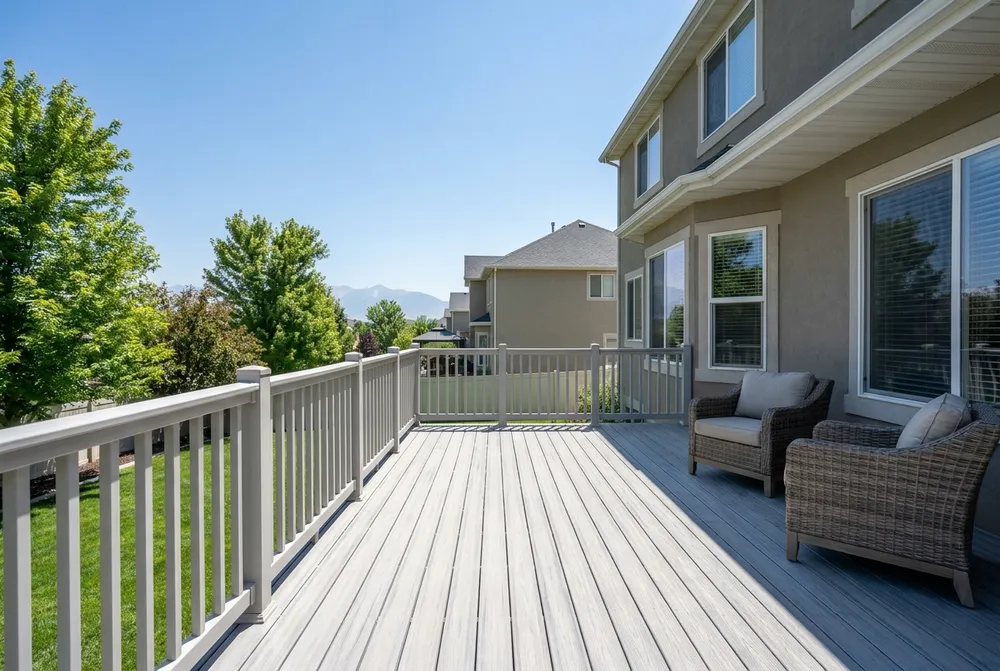
In Utah, the composite-vs-wood call is a maintenance call. Wood wants a fresh stain or seal coat every 2 to 3 years, or the freeze-thaw cycle cracks the boards. Composite wants a wash and little else. That upkeep gap, about $400 a year for wood against $10 for composite by Trex's own comparison, is what closes composite's higher $20 to $30 per square foot install price over time.
Both materials can build a solid deck. The difference shows up after the first winter, not on installation day. Trex and composite deck building is Construction Solutions of Utah's specialty, and the company builds pressure-treated wood decks too, so homeowners can compare boards side by side instead of getting steered to one line.
What does each material really cost over time, not just to build?
Installed composite decking like Trex runs about $20 to $30 per square foot, against roughly $14 to $20 per square foot for pressure-treated wood, based on 2026 decking cost guides. See the full cost breakdown for a Trex or composite deck for sizes and totals.
That gap is only the build-day number. Trex's own wood-versus-composite comparison puts wood upkeep at up to $400 a year in stain and sealant. It puts composite upkeep at about $10 a year. That is the manufacturer's own comparison, not an independent study. But it matches a national 2026 decking guide too: wood typically lasts 10 to 20 years with upkeep, while composite runs 25 to 30 years or longer. Trex backs its own lines with 25-year, 35-year, or 50-year limited residential warranties, depending on the tier you pick: Enhance, Select, or Transcend.
Spend a few years owning either deck, and the maintenance bill starts to matter as much as the install quote did.
Why does Utah's freeze-thaw cycle matter more for wood than composite?
Freeze-thaw damage happens in a set order. Moisture from melting snow or rain soaks into the wood grain. The temperature drops. That moisture freezes and expands inside the wood fibers. Each cycle creates tiny fractures. Those fractures widen over time into real cracking, splintering, and warping. A worn stain or seal coat lets moisture back in, even on a deck that was sealed the right way when it was new.
Utah gives wood a lot of chances to run that cycle. The nearest NOAA climate-normals station to Layton averages 64.3 inches of snow a year. The nearest full-data station near Kaysville, Salt Lake City International Airport, averages 51.9 inches a year. That much snow sits on a deck through the winter. It melts and refreezes again and again. That is the real reason a Utah wood deck's finish has to hold up for a whole season, not just one cold night. Layton's snow and frost-depth numbers and that same freeze-thaw exposure reach composite deck builds across Kaysville too.
Composite does not go through that same damage path. Trex and other composite boards do not soak up water the way bare wood grain does. The freeze-thaw cycle has far less moisture to work with inside the board itself.
How much upkeep does each material need, and when does it matter most?
Wood needs a stain or seal coat about every 2 to 3 years to keep that protective barrier intact. Skip a season, and the deck is exposed right as winter's freeze-thaw cycles start working on it. Composite needs occasional sweeping and a wash with soap and water. That is close to the whole job.
The timing matters as much as the task. The best time to reseal a wood deck in Utah is before fall, so the coat is fresh going into winter, not already worn thin by the time the first snow sits on the boards. Miss that window two or three years running, and the cracking and splintering that freeze-thaw causes shows up fast.
Call for a free written estimate on either material, and the crew will walk you through what your yard's sun exposure and winter snow load mean for the upkeep schedule either way.
Which one is the better fit for your Utah yard?
Pick pressure-treated wood if the lower install cost matters most and you are willing to reseal it every 2 to 3 years, on schedule, through Utah winters. Pick composite if you would rather wash the boards a couple of times a season than reseal them every few years. Across a 25-, 35-, or 50-year Trex warranty, that roughly $10-a-year upkeep is most of what the deck will ever ask of you, and the higher install price is the trade for it. If heat underfoot is a concern, a lighter Trex color, a gray or soft tan instead of a dark tone, keeps a composite deck cooler in Utah's strong summer sun.
Either board, set on 30-inch frost-depth footings and framed for Layton's 43 psf snow load or Kaysville's 140 mph wind rating, will hold up for years in a Utah yard. What splits them is the next 20 years, not day one: wood asks for a seal coat every 2 to 3 years to get there, composite asks for a hose-down. Pick the upkeep schedule you actually want to keep.
Construction Solutions of Utah is family owned, veteran owned, and locally owned and operated, based in Bountiful, UT, with three generations in the trades. The company is licensed in Utah, number 14241087-5501, and insured. Contact Construction Solutions of Utah for a free, written estimate comparing composite and wood for your exact deck, and see the deck permit rules in Layton and Kaysville for the paperwork side of the project.
Talk to Construction Solutions of Utah
Questions about your general contractor & remodeling job? We serve Bountiful and the surrounding area with honest, upfront advice.
Related articles
FAQ
Related questions
Does composite decking get hot in the sun?
It can. Composite decking can run 35 to 76 degrees hotter than the outdoor air temperature in direct summer sun, and darker boards hold more heat than lighter ones. In Utah's dry, high-UV summers, picking a lighter Trex color, like a gray or soft tan, keeps the deck more comfortable to walk on barefoot.
Does composite decking crack in cold weather?
Composite resists cracking far better than wood in freezing weather. Wood cracks because moisture soaks into the grain, freezes, and expands. Composite boards, including Trex, do not absorb water the same way, so that specific freeze-thaw damage does not happen to them the way it happens to an unsealed or worn wood deck.
Is composite decking worth the extra cost over wood?
For most Utah homeowners, yes, over time. Composite costs more to install, but Trex's own comparison puts wood upkeep at up to $400 a year against about $10 a year for composite. Spread across a 20-year wood deck's life versus a 25-to-50-year composite warranty, the maintenance savings close a real share of that upfront gap.